


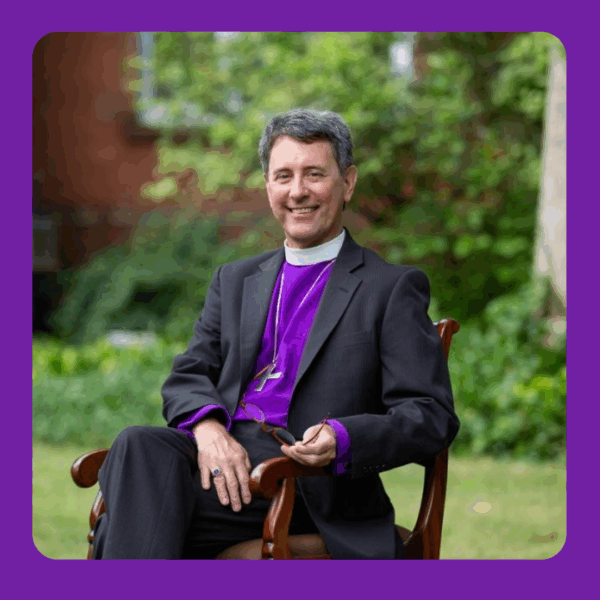
 By Bishop Stephen Andrews
Before the Reformation it was common for folk to mark the passing of a person with a memorial service on the one-month anniversary of his or her death. It is still widely practiced in Ireland among Roman Catholics and often includes a Mass.
Apart from the religious purposes of a requiem Eucharist, there are good pastoral reasons to recall the death of a loved one on his or her monthly anniversary. One is because it is an opportunity, after the funeral is over and after the sympathy cards have ceased to be delivered, to express continuing love and support to those who have been most affected by the loss. Another reason is that the fuller measure of what has been lost is not always evident in the moments when grief is fresh. It is when life begins to settle into new routines that we find ourselves suddenly missing the departed, often in unexpected ways. I think of Jay every time I hear Terry O’Reilly on the radio, or encounter something new in liturgy.
On April 13, it will be one month since Jay Koyle died, and I wanted to take this occasion to pay tribute to him in some small way. I want to do this by reminding us of three of the most important things he taught us.
1. Congregational development is about people development, not program development
Jay was influenced in his thinking by the work of the late Rodney Stark, a sociologist of religion who wrote about church growth and decline. Stark noted that the early church expanded through social networks—through relationships that are lived witnesses to the transforming power of the gospel. Such relationships were primary to Jay, and he understood that congregational development was more a matter of what a church is than what it does.
A pastor at heart, Jay went about the task of congregational development by forming relationships with parishioners and their leaders across the diocese. He helped them to identify the foundational values of God’s kingdom, and worked to strengthen the connections between church communities. A notable example of this was the work he did in assisting lay readers in honing their skills. It was his conviction that, at their baptism, every Christian received spiritual gifts that were intended to serve the Body of Christ, and that it is through the faithful exercise of these gifts that the church is nurtured towards maturity.
There are a number of resources and platforms churches use to encourage organisational change, and many of our congregations have used these tools. But programs do not make healthy churches. People do. And so Jay’s first loyalty was to the people he served, including his bishop.
2. Mission statements can be dangerous
When Jay joined our diocesan team in 2010 he said that he was not interested in helping congregations to develop mission statements. This surprised and even alarmed some. The crafting of mission statements is a core skill in the congregational development officer’s strategic toolkit. Originally conceived by management theorists only 60 years ago, they are now ubiquitous in corporations, universities, and churches. And they have their place. Mission statements help to consolidate an organisation’s identity, purpose, and values.
Jay, of course, understood this. But Jay also knew that mission statements could stunt or even harm church growth. He had seen where the process of coming up with a parish mission statement had the consequence of dividing a congregation because of the different priorities held by congregation members. In other situations, he said, it was clear that the statements were being designed primarily for branding and marketing purposes, and were not a true description of the community. Moreover, he warned that many statements were aspirational to the degree that they were unrealistic. The inability of a congregation to embody a mission statement in any meaningful way could be demoralising or undermine the church’s integrity.
For Jay, the crucial question was not, What is your mission? but, What is God’s mission? He would often challenge us to pay attention to what God is doing in the world, and then to get with that program. He taught us that we understand the divine mission best when we listen to Scripture attentively, when we pay attention to the needs around us, and when we participate in the drama of the gospel in the Eucharist. The best parish mission statement is the parish that is actively participating in the mission of God.
3. Remember the future
In his eulogy, Dean Kevin George of Huron quoted one of Jay’s sermons where he described “backward memory.” Using an episode from Alice in Wonderland, Jay said that Christians live in a paradoxical reality where memories can work both backward and forward. This was a favourite theme of his, and it shaped what many regarded as a natural optimism in his character.
But for Jay, his living in the future was more profound than that. He talked about how Israel was constantly told to “remember” their past deliverance. Why? So that they could embrace their identity and direction, so that they would know how to live in the world as God’s chosen ones. Jay loved to tell us about the promises of God—promises that we remember but which have not yet come to fulfilment.
He admitted that there is a sense in which this means adopting a long view. We seem so far from the kingdom. Nevertheless, we must live in this future, he said. We must act now as if the promised future is real, because it is real. We must not give in to cynicism or despair, but we must act confidently in the promises of God.
Some, perhaps, thought this naïve. But Jay firmly believed its truth because he was an Easter Christian. His convictions were grounded in the death and resurrection of Jesus Christ. This is why one of his favourite eucharistic refrains was: Christ has died. Christ is risen. Christ will come again. I am grateful for Jay’s joyful certainty and I delight in the prospect that those who have gone before us in the way of Christ now live in the fulness of the future we now remember.
Jay’s work as our Congregational Development Officer ushered in a process of meaningful change for the diocese. With the assistance of many others, he designed what we called “benchmarks for healthy congregations,” and he helped us towards the goals of “vision, vitality and viability.” In a context where many were concerned about survival, Jay’s sights were fixed on flourishing. Of course, the kingdom did not arrive as a result of his work among us. But, in God’s goodness, it did come a little closer in Jay’s teaching, preaching and friendship.
For this I will always be thankful. May his memory continue to inspire us: to treasure the value of one another, to pursue God’s mission, and to remember our future. And may this brief tribute be a source of comfort to those who grieve his loss most deeply.
Eastertide blessings to you all,
+Stephen